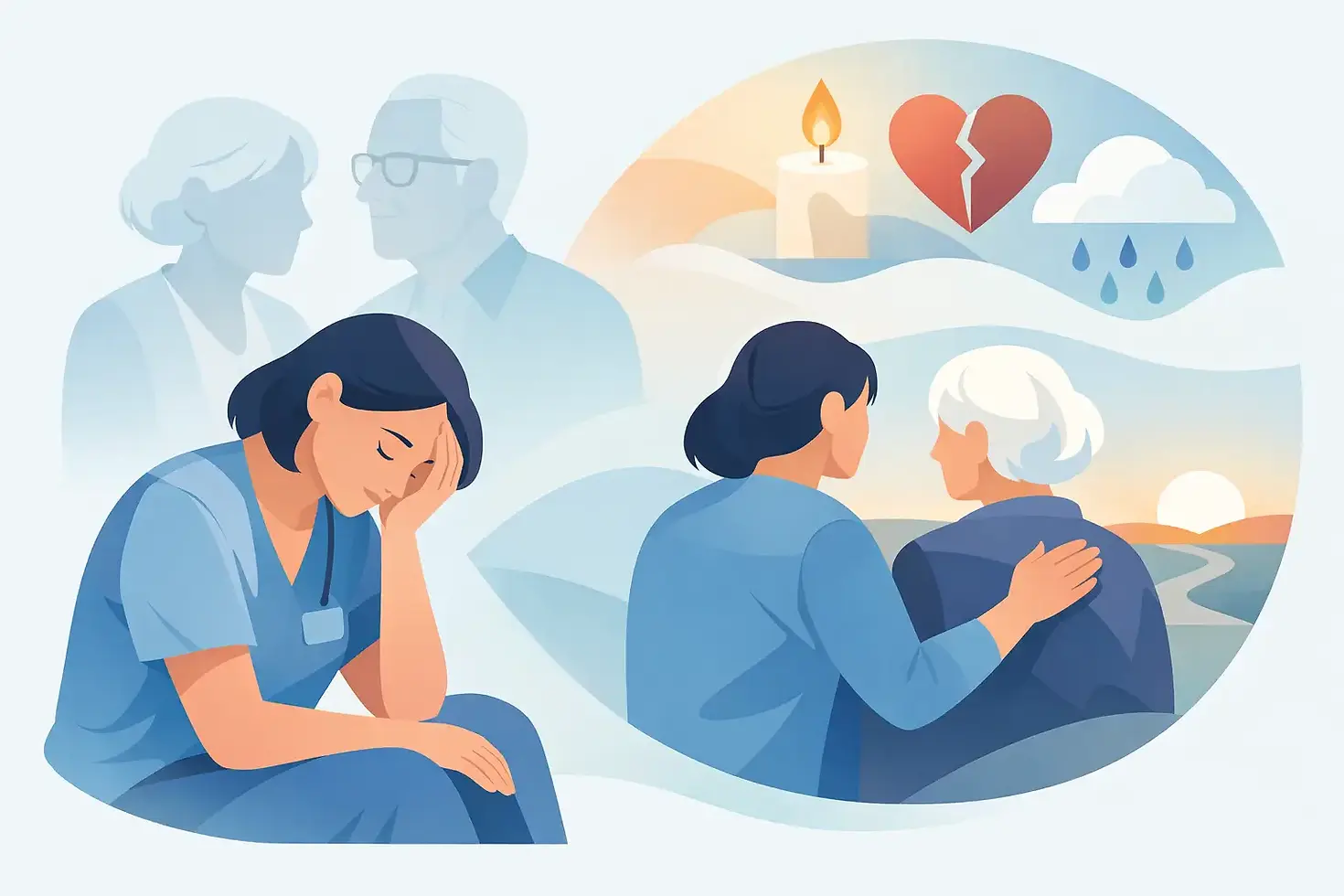
Understanding Professional Caregiver Grief

A nurse folds a patient’s blanket one last time. A home caregiver locks the front door after months of daily visits. A funeral director listens to a family’s stories, then returns to a quiet office once everyone has gone home. These moments rarely look dramatic from the outside, yet this is often where professional caregiver grief begins.
Professional caregiver grief is the sorrow, emotional strain, and sometimes lingering sense of loss felt by those who care for others as part of their work. It can affect nurses, hospice staff, funeral professionals, social workers, eldercare teams, home health aides, and anyone whose role involves walking closely with individuals and families through illness, decline, death, and mourning. Because the relationship is professional, people often assume the grief should be lighter or easier to set aside. In reality, that is not always true.
Why professional caregiver grief is often overlooked
Caregiving professions are built on composure. Families need calm guidance. Patients need reassurance. Colleagues rely on one another to keep standards high, especially when emotions are intense and decisions must be made carefully. Over time, this can create an unspoken belief that grief should be managed privately and quickly.
That expectation is rarely realistic. Professional closeness may have boundaries, but it is still closeness. When someone has been present through treatments, setbacks, conversations about hope, spiritual rituals, or final arrangements, a real human bond often forms. The fact that payment is involved does not remove care, and training does not cancel sorrow.
There is also a practical reason this grief goes unnoticed. Professionals are usually expected to continue working while losses accumulate. A caregiver may support one family in the morning and another by afternoon. A funeral team may move from one service to the next with little time to pause. Grief can become layered, especially in settings where death is not rare but part of the work itself.
What professional caregiver grief can look like
Professional caregiver grief does not always appear as open tears or visible distress. Sometimes it shows up as fatigue that lingers beyond normal tiredness. Sometimes it looks like irritability, numbness, difficulty concentrating, or a reluctance to grow close to the next person who needs care.
For some, grief is quiet and deeply personal. A caregiver may remember a patient’s favorite song, the way a spouse held vigil, or the dignity of a final farewell. Those memories can stay tender for years. For others, the distress is more complicated. If a death was sudden, traumatic, or accompanied by conflict among family members, the caregiver may carry unresolved feelings that are harder to process.
It also depends on the nature of the role. A hospice nurse who has walked with a patient for months may feel grief differently than an emergency clinician who faces repeated sudden losses. A funeral professional may experience a different kind of sorrow - one shaped not by clinical care, but by sustained exposure to mourning, ritual, and the weight of helping families honor a life with dignity.
The difference between grief, burnout, and compassion fatigue
These terms are often used together, but they are not exactly the same. Grief is a response to loss. Burnout usually develops from chronic workplace stress, high demands, low support, or emotional exhaustion over time. Compassion fatigue often describes the wear that comes from repeated exposure to suffering.
In real life, they can overlap. A caregiver who is grieving may also be burned out. Someone under heavy pressure may find each new loss harder to bear. That is why simple advice such as “take a day off” or “try not to get attached” often misses the point. The issue is not weakness. It is cumulative emotional labor.
Recognizing the difference matters because support should match the experience. If the core issue is grief, what helps may include acknowledgment, reflection, memorial rituals, or peer support. If the core issue is organizational strain, staffing, supervision, and workload may need attention too.
Why acknowledgment matters in caregiving professions
One of the most painful parts of professional caregiver grief is disenfranchisement - grief that is real but not fully recognized by others. When a family member grieves, their loss is visible and socially accepted. When a professional grieves, people may assume it is just part of the job.
But being expected to handle loss does not mean loss leaves no mark. In many care settings, professionals are present at sacred thresholds of life. They witness fear, courage, reconciliation, regret, faith, and love. To move through these moments with dignity requires emotional presence, not emotional absence.
This is especially true in funeral and memorial care. Professionals in this field are entrusted with both logistics and ceremony. They coordinate details with precision while standing beside families in some of their most vulnerable hours. That dual responsibility can be deeply meaningful, but it also carries emotional weight. A premium standard of care is not only operational. It is relational.
How organizations can respond with dignity
Support for professional caregiver grief should not feel performative. It needs to be respectful, practical, and consistent. A workplace culture that values dignity should extend that same dignity to its own staff.
That starts with permission. When leaders acknowledge that grief can affect professionals, they remove some of the silence around it. Brief check-ins after difficult cases, access to counseling, reflective supervision, and space for team debriefs can make a real difference. Not every staff member will want to process emotion in the same way, so support should be available without being forced.
Ritual can help too. In caregiving and memorial professions, ritual is not only for families. Simple internal practices such as a moment of silence, a remembrance board, or quiet reflection after a demanding case can provide closure. These gestures do not erase grief, but they honor it appropriately.
Workload also matters. Emotional resilience is harder to sustain when teams are stretched thin. Rest, reasonable scheduling, and strong operational systems are not luxuries. They protect the quality of care and the well-being of the people delivering it.
What individual caregivers can do without shutting down
For professionals, healthy coping is not about becoming detached. It is about staying compassionate without carrying every loss alone. That balance takes effort, and it may look different at different stages of a career.
Some caregivers benefit from naming the loss directly, whether in a journal, in supervision, or in private reflection. Others find stability through faith practices, counseling, or peer conversations with people who understand the nature of the work. What matters is having a place where the emotional reality of the role can be expressed honestly.
Boundaries are part of that care, but boundaries should not be confused with emotional denial. A strong boundary allows a professional to serve with presence and then return to personal life with greater steadiness. Suppressing grief entirely often does the opposite. It can harden a person over time or leave them unexpectedly overwhelmed.
There is also value in recognizing meaning. Many professionals remain in caregiving roles not because the work is easy, but because it is profound. Remembering that a patient was comforted, that a family felt guided, or that a farewell was conducted with grace can help grief sit alongside purpose rather than only pain.
Professional caregiver grief in funeral and bereavement care
In funeral service, grief is both the setting and the responsibility. Professionals must attend to timing, documentation, ceremonial details, religious and cultural needs, and family expectations, often within compressed timelines. At the same time, they are standing in the presence of fresh loss.
This can create a particular form of professional caregiver grief. Funeral staff may not have known the deceased for years, yet they are drawn into the family’s story quickly and intimately. They hear memories, witness strained relationships, manage fragile emotions, and help shape final acts of respect. Doing this well requires compassion with discipline.
For families, this kind of guidance brings peace of mind. For professionals, it can leave a quiet emotional residue if not acknowledged. That is why bereavement care organizations should build support into their own culture, not only their client services. A company such as Nirvana Funeral Service, which emphasizes dignity, structured care, and meaningful farewell arrangements, reflects the kind of environment where that principle should extend to staff as well as families.
Professional caregiver grief is not a sign that someone is unsuited to the work. More often, it is evidence that they have done the work with genuine humanity. When that grief is met with respect instead of silence, caregivers are better able to continue serving others with steadiness, compassion, and honor.
The people who guide others through loss also deserve care that is thoughtful, dignified, and real.


Comments