
Catholic Funeral Service Steps Explained

When a Catholic death occurs, families are often asked practical questions before they have had time to take in the loss. Is there a wake? Will there be a funeral Mass? What happens at the cemetery? Understanding catholic funeral service steps can ease some of that pressure and help families make decisions with greater calm, clarity, and reverence.
Catholic funerals follow a sacred structure, but there is still room for pastoral guidance based on the family's needs, the parish, and local customs. In many cases, the process includes three main parts: the vigil or wake, the funeral liturgy, and the rite of committal. Knowing how each part fits together can make the days ahead feel more manageable.
What are the Catholic funeral service steps?
The Catholic Church views the funeral not simply as a ceremony, but as a prayerful farewell entrusted to God. The three main catholic funeral service steps are usually the vigil for the deceased, the funeral Mass or funeral liturgy outside Mass, and the committal at the place of burial or entombment.
This structure reflects both faith and pastoral care. It gives family and friends time to gather, pray, grieve, and accompany the deceased with dignity. While many families expect a single service, Catholic tradition is fuller than that. Each stage carries its own meaning, and together they form a complete act of remembrance and hope.
Step 1: The vigil or wake
The vigil is often the first public moment of prayer after death. It may take place at a funeral home, church, chapel, or family residence, depending on the parish and local practice. For many families, this is also the time when relatives and friends come to pay respects, offer condolences, and spend quiet moments near the deceased.
In Catholic tradition, the vigil is more than visitation. It usually includes scripture readings, intercessions, and prayers for the soul of the departed. In some settings, the Rosary may be prayed, especially if the family wishes to include Marian devotion as part of the farewell.
There can be some variation here. Some families prefer a simple prayer service with limited formal speaking, while others include eulogies or remembrance sharing during the wake rather than during the Mass. This often depends on parish guidance, family preference, and how the overall funeral schedule has been arranged.
If the family is coordinating funeral care with a professional provider, this is also when many logistics are finalized. Visitation timing, transport, floral arrangements, prayer materials, and ceremonial setup all need to work in harmony. Quiet coordination matters because it allows the family to remain focused on presence rather than pressure.
Step 2: The funeral liturgy
The second and most central of the catholic funeral service steps is the funeral liturgy. When possible, this is celebrated as a Funeral Mass in a Catholic church. If a Mass is not appropriate or cannot be arranged, the Church may offer a funeral liturgy outside Mass.
The Funeral Mass places the deceased within the prayers of the Church and the saving promise of Christ. It commonly begins with the reception of the body at the church. Holy water may be used as a reminder of baptism, and a funeral pall is often placed over the casket as a sign of Christian dignity and equality before God.
The liturgy then moves through the Liturgy of the Word, with scripture readings, a responsorial psalm, the Gospel, and a homily. The homily is not meant to be a biography or tribute speech. Its purpose is to proclaim Christian hope in the face of death and to pray for the deceased with faith and tenderness.
If a Funeral Mass is celebrated, the Liturgy of the Eucharist follows. This is a deeply meaningful part of the service for practicing Catholics, as the community gathers around the altar in prayer and communion. Music is usually sacred rather than sentimental, and selections are typically guided by church norms.
Families sometimes ask about personal touches. This is an area where expectations should be handled carefully. Catholic funerals welcome respectful participation, but they are not fully customized events in the modern sense. Favorite secular songs, lengthy speeches, or dramatic presentations are usually better placed at the wake or a private gathering rather than inside the liturgy itself.
That said, there is often room for family involvement in meaningful ways. Loved ones may help choose approved readings, serve as lectors, bring up the offertory gifts, or select sacred music in consultation with the parish. The balance is important. A Catholic funeral is personal, but it is also rooted in the prayer and order of the Church.
Step 3: The rite of committal
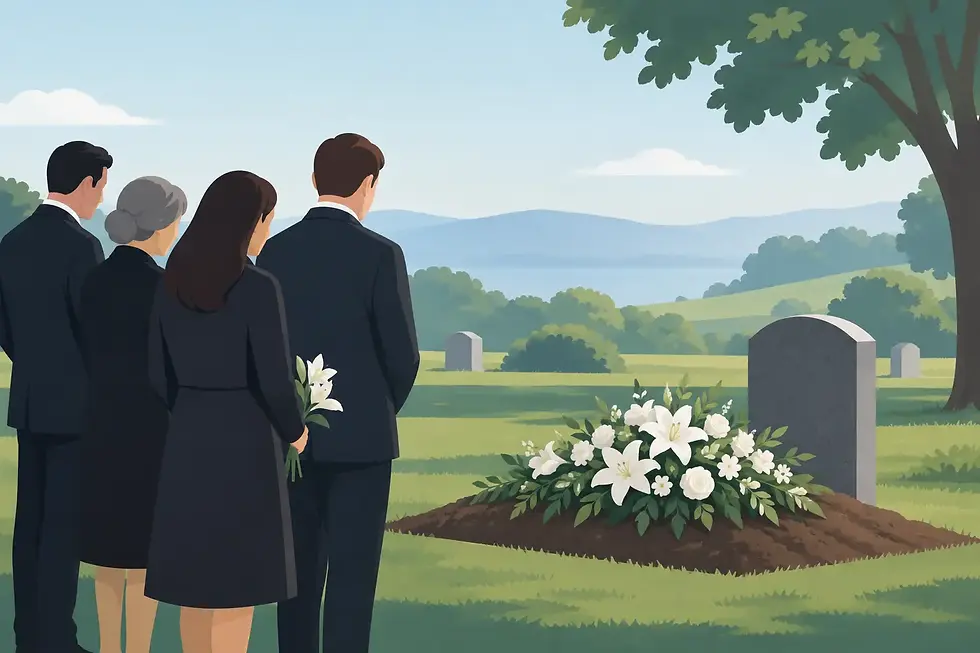
The final of the catholic funeral service steps is the rite of committal. This takes place at the cemetery, mausoleum, or place of interment. Though it is often brief, it is a significant moment. This is where the Church commends the deceased to God and where the body is laid to rest with solemnity.
At the committal, prayers are offered over the place of burial or entombment. There may be scripture, intercessions, and a final blessing. For many families, this is the most emotionally difficult part of the funeral because it marks the physical leave-taking.
Even so, the committal can also bring a quiet sense of peace. The ritual gives shape to a moment that might otherwise feel unbearable. Instead of standing in silence with uncertainty, the family is accompanied through prayer, order, and reverence.
For cremation, the Catholic Church permits it, provided it is not chosen for reasons contrary to Christian teaching. In most cases, the preference is that the funeral liturgy take place with the body present before cremation. After cremation, the cremated remains should still be treated with the same respect as the body and placed in a sacred resting place rather than kept casually at home or divided among relatives.
Planning choices families may need to make
Even with a clear structure, Catholic funerals still involve decisions. One of the first is whether the parish will celebrate a Funeral Mass or a liturgy outside Mass. This may depend on priest availability, pastoral circumstances, or whether the deceased was a baptized Catholic in good standing.
Families also need to confirm whether there will be a public wake, a private vigil, or both. In some communities, a one-day arrangement is preferred for practical reasons. In others, a longer visitation is customary because it allows extended family and friends time to gather.
Music and readings are another important area. Since Catholic liturgy follows religious guidelines, approved hymns and scripture passages should be selected in consultation with the parish. This protects the sacred character of the service while still allowing the family to reflect the spiritual life of the deceased.
There are also practical matters that deserve careful handling: church scheduling, cemetery coordination, transport of the deceased, obituary support, memorial items, and reception planning. During grief, these details can feel overwhelming. Professional funeral guidance can make a meaningful difference by bringing order, timeliness, and dignity to each stage.
Why understanding the process helps
The value of knowing the catholic funeral service steps is not simply administrative. It helps families participate with intention. When people understand what is happening and why, they are less likely to feel lost in the middle of a solemn day.
It also reduces unnecessary conflict. In many families, different generations carry different expectations. Some may want a more traditional Catholic format, while others may imagine a more personalized memorial service. Understanding what the Church requires and where flexibility exists can help everyone move forward respectfully.
This is especially true when burial or memorial planning must happen quickly. A provider experienced in both ceremonial care and practical coordination can support the family from first call through final committal, helping preserve peace of mind at a time when emotions are understandably heavy. For families seeking that kind of steady guidance, premium funeral care providers such as Nirvana Funeral Service often play a valuable supporting role alongside the parish.
A farewell shaped by faith and care
A Catholic funeral is not rushed, even when the timeline is short. It unfolds in a deliberate way: prayer at the vigil, worship at the funeral liturgy, and final blessing at the committal. Each stage honors the life that has ended while placing that life in the mercy of God.
For grieving families, that structure can be a quiet mercy in itself. When the next steps are clear, there is more room to mourn, to pray, and to stand together with dignity as you entrust your loved one to a sacred farewell.


Comments